
The Hidden
Psychology of
Leadership
Beneath every leadership style lies a psychological architecture.
No leader arrives in their role as a blank slate.
Long before we develop strategies for leading organisations, we develop ways of navigating relationships, managing uncertainty and finding our place in the world.
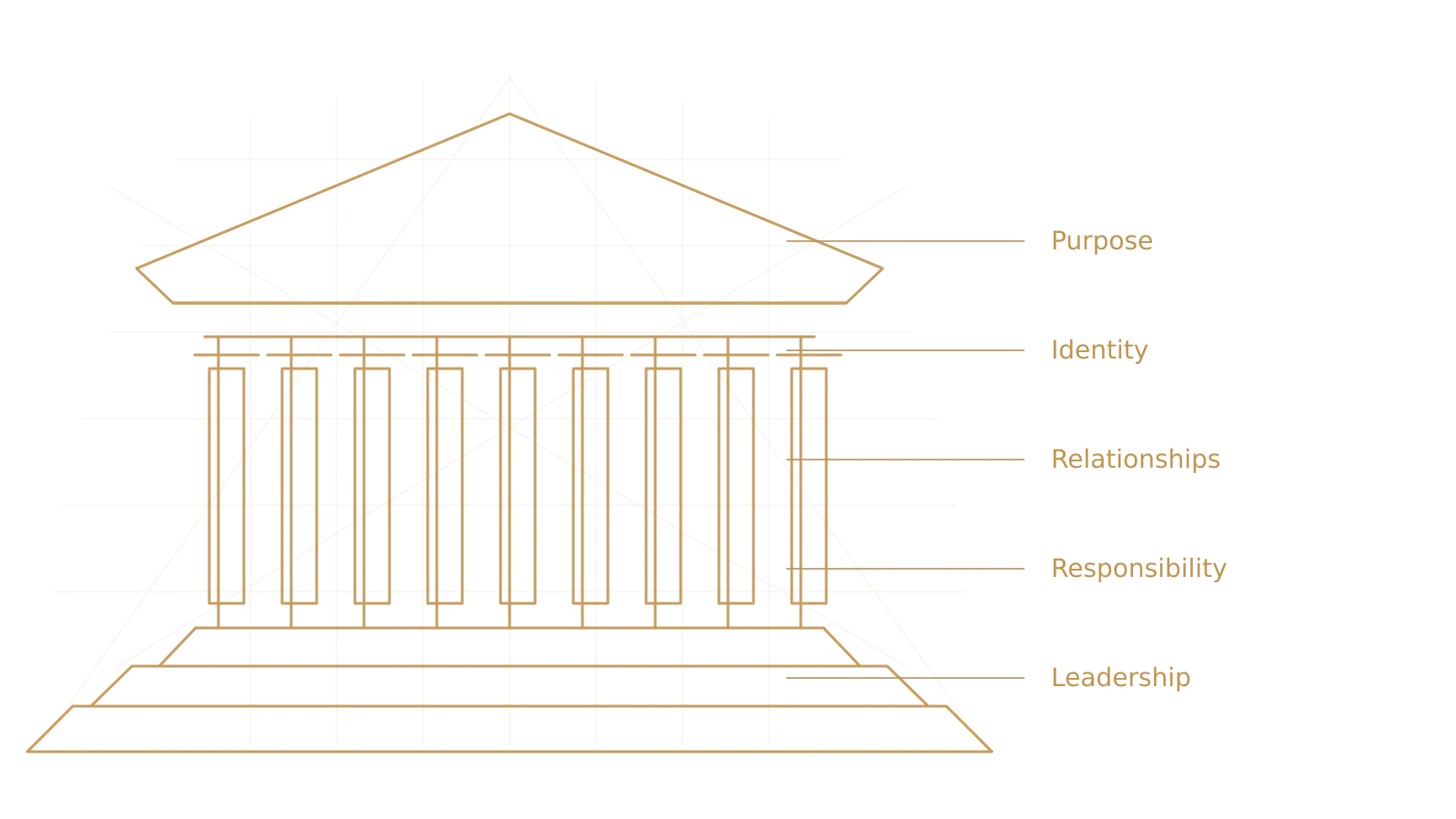
How the architecture is formed
- We learn what it means to succeed.
- How to respond to expectation.
- Whether mistakes feel tolerable or dangerous.
- Whether asking for help feels possible.
- Whether responsibility becomes something we willingly carry or something we feel unable to put down.
These ways of being are rarely conscious.
They become woven into our personalities over many years, shaped by our experiences, relationships and environments.
They influence how we think, how we make decisions, how we respond under pressure and how we relate to the people around us.
Many of these patterns serve us remarkably well.
Adaptations that become strengths
The leader who strives for excellence may once have learned that achievement created safety or recognition.
The leader who finds it difficult to delegate may have discovered early that relying upon others carried risk.
The leader who feels responsible for everyone may have developed an identity built around meeting the needs of others before recognising their own.
When success becomes costly
Yet the very patterns that contribute to success can also become increasingly costly.
- Perfection becomes relentless self-criticism.
- Responsibility becomes emotional burden.
- Independence becomes isolation.
- Achievement becomes something that can never quite feel sufficient.
- Control becomes anxiety whenever uncertainty cannot be eliminated.
What once enabled leadership can gradually begin to constrain it.
This is not because those patterns are wrong.
It is because they continue operating long after the circumstances that created them have changed.
Executive psychotherapy is not concerned with removing these patterns or replacing one leadership style with another.
Its purpose is to understand them.
Because understanding changes our relationship with ourselves.
Patterns that once felt automatic become visible.
Responses that once felt inevitable become choices.
Leadership becomes less driven by unconscious adaptation and more informed by conscious awareness.
The Architecture of Leadership™
This is the foundation of The Architecture of Leadership™.
A way of understanding leadership not simply through behaviour or performance, but through the psychological structures that quietly shape how we think, relate, carry responsibility and experience ourselves.
Every leader has an architecture.
Not one that determines who they must become.
But one that helps explain who they have become—and how greater awareness creates greater freedom.
When the architecture is understood, the conversation changes.
Once we begin to understand the architecture beneath leadership, the conversation itself changes.
It moves beyond problem-solving and performance.
It becomes an opportunity to explore the person behind the position, the patterns beneath the decisions and the possibilities that emerge when leadership is understood from the inside as well as the outside.